Comic Strip History - The Grawlix
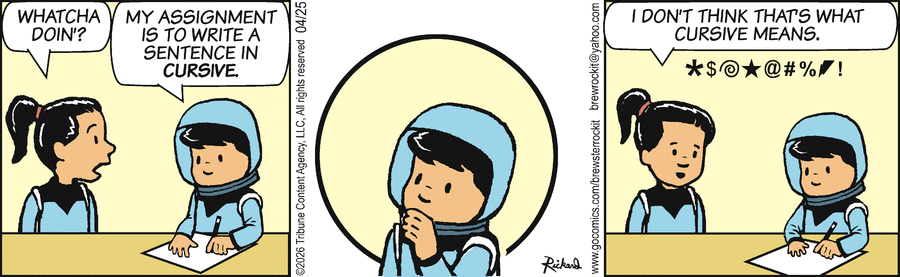 In times past, when I’ve covered words or phrases that originated in a comic strip, generally they had a major effect only on the English language, and sometimes only American English. This time, however, we have something that appears to have affected multiple cultures and languages across the world, even while still remaining entirely unpronounceable. Everyone has seen it, and it’s immediately recognizable. It’s a series of punctuation marks and symbols that indicate someone or something is emitting profane or vulgar language (for example, “@&%$!"), which these days is most commonly known as a grawlix.
The first appearance of a grawlix, that we know of, was in a strip called Lady Bountiful, drawn by Gene Carr, published on November 1, 1901. Ruldolph Dirks, creator of the Katzenjammer Kids, is often cited as the first to use a grawlix, but examples of this in Dirks' work can’t be found until a year after the Lady Bountiful strip. However, the popularity of the Katzenjammer Kids was certainly instrumental in popularizing its use. Given that one of the main characters of the strip was a ship captain, and the strip would often feature other characters who were sailors, they cursed just like them, too. Such cursing would, of course, be “censored” by the grawlix.
In the earliest uses, all types of symbols were included, not just punctuation marks, though the exclamation point was very common and was generally expected to appear. Other common symbols were five-pointed stars, spirals, skulls, and in the case of Dirks' sailors, an anchor. Grawlices have mainly been used in comic strips with a more humorous tone; they have always exuded a certain air of whimsy, so they may seem out of place in a strip with more serious drama. Still, they can bring a more fun and comedic air to an action and adventure strip, and cartoonists such as Harold Gray, in Little Orphan Annie, and Chester Gould, in Dick Tracy, were not afraid to employ them from time to time.
It wouldn’t take long for this to become a convention in not only newspaper comics, but also comic books. In the modern age, it seems the grawlix has broken free of comics entirely, and can often be seen in various textual media, everywhere from published books to social media posts. While I’m not an Internet historian, I can also imagine it being very useful even from the early days of the Internet, back when the only way to send information of any kind was through the use of text. Further, because of the nature of it, the grawlix isn’t restricted to use within any particular language. People around the world are able to use it and still be understood. In fact, the official emoji for an angry person using profanity (🤬) (officially known as “serious face with symbols covering mouth”) has a censor bar with a grawlix on it.
But where did the word “grawlix” come from?
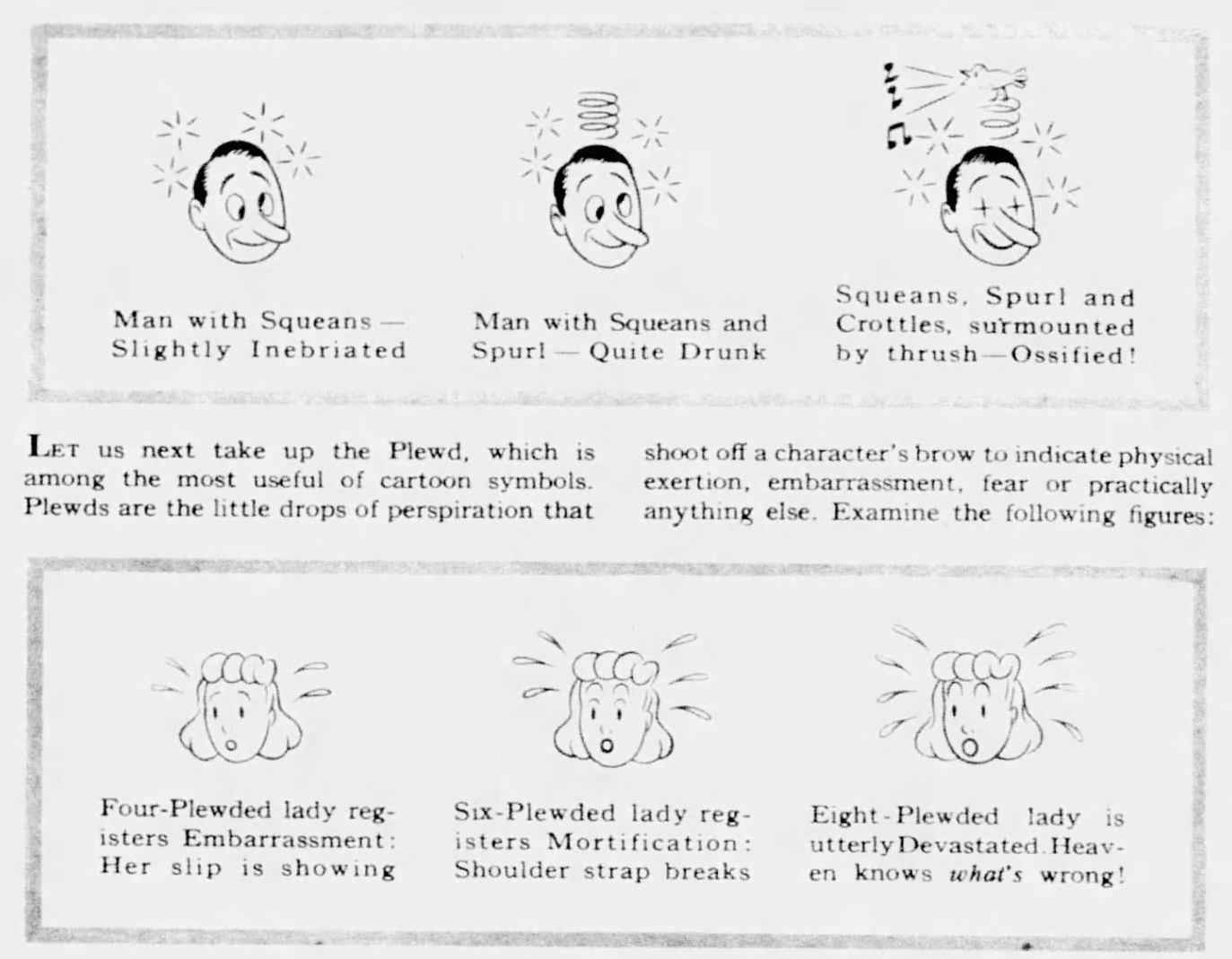
In 1946, columnist Charles Rice in the newspaper supplement tabloid This Week wrote a humorous column titled “Squeans, Plewds, and Briffits, or How to Be A Cartoonist,” in which he presented several visual conventions of comic strips along with the names of such. The column was written in a way that suggested these words already existed and were in use among cartoonists, though Rice had made them all up himself. There was, however, no mention of a grawlix in Rice’s column. At that time and since, one can find others using words and phrases such as “cursing characters” or “obscenicons,” but “grawlix” had not yet been invented.
In times past, when I’ve covered words or phrases that originated in a comic strip, generally they had a major effect only on the English language, and sometimes only American English. This time, however, we have something that appears to have affected multiple cultures and languages across the world, even while still remaining entirely unpronounceable. Everyone has seen it, and it’s immediately recognizable. It’s a series of punctuation marks and symbols that indicate someone or something is emitting profane or vulgar language (for example, “@&%$!"), which these days is most commonly known as a grawlix.
The first appearance of a grawlix, that we know of, was in a strip called Lady Bountiful, drawn by Gene Carr, published on November 1, 1901. Ruldolph Dirks, creator of the Katzenjammer Kids, is often cited as the first to use a grawlix, but examples of this in Dirks' work can’t be found until a year after the Lady Bountiful strip. However, the popularity of the Katzenjammer Kids was certainly instrumental in popularizing its use. Given that one of the main characters of the strip was a ship captain, and the strip would often feature other characters who were sailors, they cursed just like them, too. Such cursing would, of course, be “censored” by the grawlix.
In the earliest uses, all types of symbols were included, not just punctuation marks, though the exclamation point was very common and was generally expected to appear. Other common symbols were five-pointed stars, spirals, skulls, and in the case of Dirks' sailors, an anchor. Grawlices have mainly been used in comic strips with a more humorous tone; they have always exuded a certain air of whimsy, so they may seem out of place in a strip with more serious drama. Still, they can bring a more fun and comedic air to an action and adventure strip, and cartoonists such as Harold Gray, in Little Orphan Annie, and Chester Gould, in Dick Tracy, were not afraid to employ them from time to time.
It wouldn’t take long for this to become a convention in not only newspaper comics, but also comic books. In the modern age, it seems the grawlix has broken free of comics entirely, and can often be seen in various textual media, everywhere from published books to social media posts. While I’m not an Internet historian, I can also imagine it being very useful even from the early days of the Internet, back when the only way to send information of any kind was through the use of text. Further, because of the nature of it, the grawlix isn’t restricted to use within any particular language. People around the world are able to use it and still be understood. In fact, the official emoji for an angry person using profanity (🤬) (officially known as “serious face with symbols covering mouth”) has a censor bar with a grawlix on it.
But where did the word “grawlix” come from?
In 1946, columnist Charles Rice in the newspaper supplement tabloid This Week wrote a humorous column titled “Squeans, Plewds, and Briffits, or How to Be A Cartoonist,” in which he presented several visual conventions of comic strips along with the names of such. The column was written in a way that suggested these words already existed and were in use among cartoonists, though Rice had made them all up himself. There was, however, no mention of a grawlix in Rice’s column. At that time and since, one can find others using words and phrases such as “cursing characters” or “obscenicons,” but “grawlix” had not yet been invented.
 Enter Mort Walker.
Clearly inspired by Rice’s column, Walker, creator of Beetle Bailey, wrote a column for the National Cartoonists Society magazine The Cartoonist entitled “Let’s Get Down To Grawlixes.” This column, published in 1964, cites Rice as an inspiration and includes all of the words he coined in his article for This Week, but goes even further by coining terms for many other visual conventions of the comics medium, including the grawlix. Of the grawlix, Walker wrote:
> A variety of acceptable curse words are at the cartoonist’s disposal. He may throw in a new one from time to time, but the real meat of the epithet must always contain plenty of jarns, quimps, nittles, and grawlixes, as shown.
In his book Mort Walker’s Private Scrapbook, Walker says this article was originally meant to only be a joke, but his son Brian convinced him to expand the idea into an entire book. In 1980, this would become the seminal reference work for all of these comic words, The Lexicon of Comicana.
As a side note, despite citing Rice as an inspiration in the The Cartoonist article, in Private Scrapbook Walker claims to have invented all of the words he included in the Lexicon which, as has been shown, is not true. Many of the words both in the The Cartoonist article and in the Lexicon were borrowed from Rice, and in the Lexicon Walker even recreated Rice’s illustrations of plewds and squeans, complete with Rice’s captions. That said, in his book Backstage At the Strips, Walker begins by writing, “If the stories in this book are not exactly told the way they happened, it’s the way they should have happened if God had been a better gagwriter – or if I’d had a better memory.” So I guess that applies to Private Scrapbook as well.
Enter Mort Walker.
Clearly inspired by Rice’s column, Walker, creator of Beetle Bailey, wrote a column for the National Cartoonists Society magazine The Cartoonist entitled “Let’s Get Down To Grawlixes.” This column, published in 1964, cites Rice as an inspiration and includes all of the words he coined in his article for This Week, but goes even further by coining terms for many other visual conventions of the comics medium, including the grawlix. Of the grawlix, Walker wrote:
> A variety of acceptable curse words are at the cartoonist’s disposal. He may throw in a new one from time to time, but the real meat of the epithet must always contain plenty of jarns, quimps, nittles, and grawlixes, as shown.
In his book Mort Walker’s Private Scrapbook, Walker says this article was originally meant to only be a joke, but his son Brian convinced him to expand the idea into an entire book. In 1980, this would become the seminal reference work for all of these comic words, The Lexicon of Comicana.
As a side note, despite citing Rice as an inspiration in the The Cartoonist article, in Private Scrapbook Walker claims to have invented all of the words he included in the Lexicon which, as has been shown, is not true. Many of the words both in the The Cartoonist article and in the Lexicon were borrowed from Rice, and in the Lexicon Walker even recreated Rice’s illustrations of plewds and squeans, complete with Rice’s captions. That said, in his book Backstage At the Strips, Walker begins by writing, “If the stories in this book are not exactly told the way they happened, it’s the way they should have happened if God had been a better gagwriter – or if I’d had a better memory.” So I guess that applies to Private Scrapbook as well.
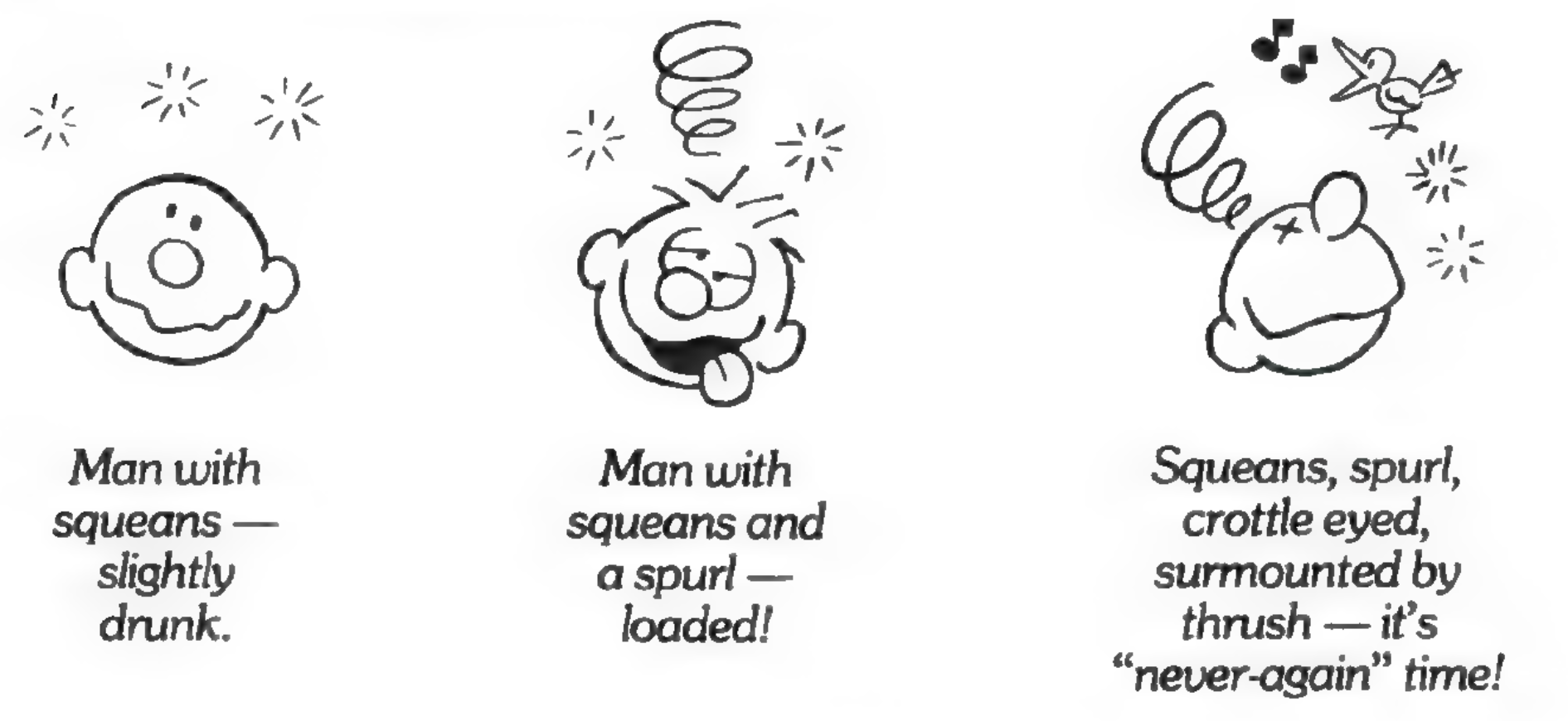
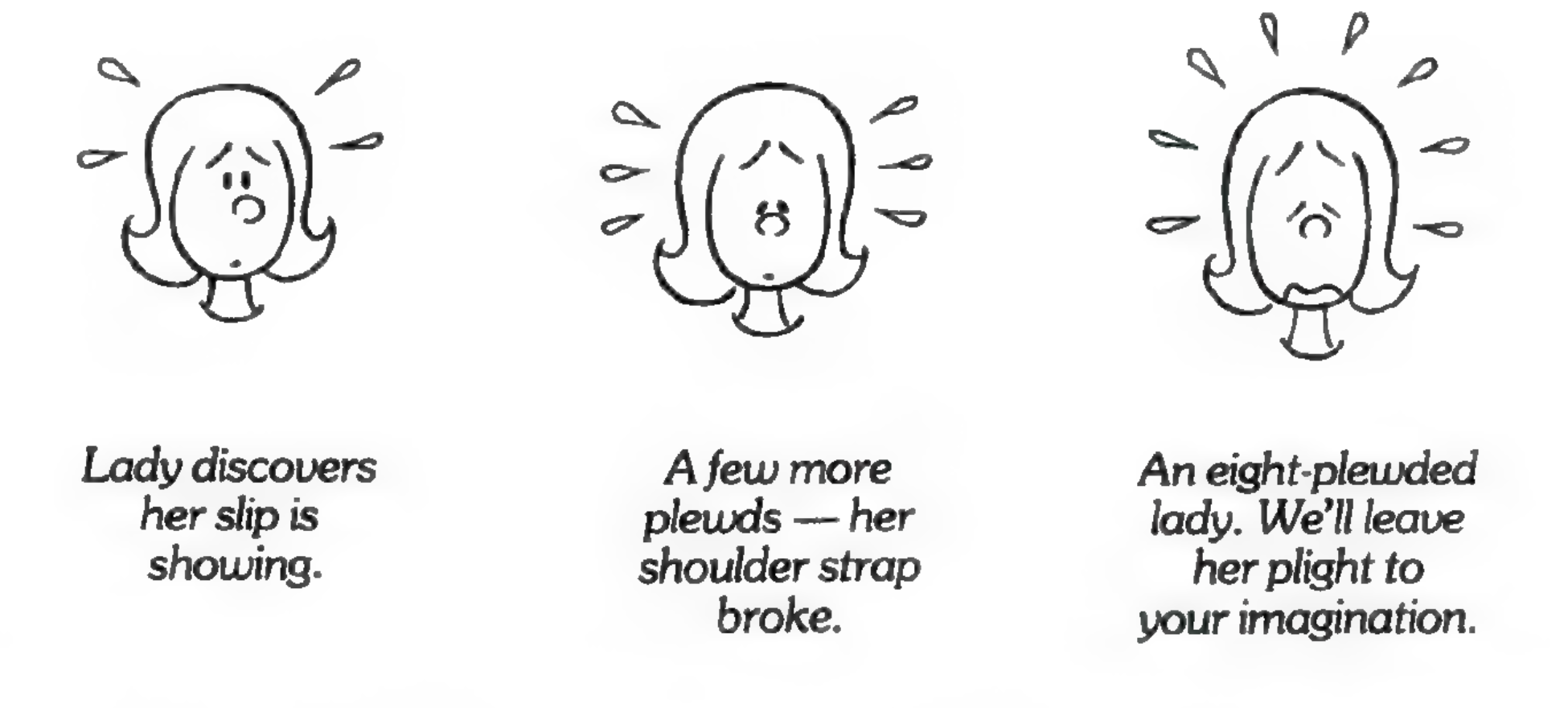 But I digress. In The Lexicon of Comicana, in a section of the book titled “Maladicta,” Walker introduces the grawlix and its relatives in a way similar to their introduction in the The Cartoonist article:
> Even in today’s permissive society many four letter words are not permissible in the comics. Even though profanity may be used in other sections of the paper, people feel that, since children read cartoons, the comic section should be inviolate. Cartoonists, therefore, have had to develop acceptable substitutes. A first sergeant would lose a lot of his charm if he said, “Gee whiz, Beetle. You make me so terribly mad!” So the creative mind came up with a variety of “jarns,” “quimps,” “nittles,” and “grawlixes” to help convey a sergeant’s strong emotion and add color and dimension to his personality.
But I digress. In The Lexicon of Comicana, in a section of the book titled “Maladicta,” Walker introduces the grawlix and its relatives in a way similar to their introduction in the The Cartoonist article:
> Even in today’s permissive society many four letter words are not permissible in the comics. Even though profanity may be used in other sections of the paper, people feel that, since children read cartoons, the comic section should be inviolate. Cartoonists, therefore, have had to develop acceptable substitutes. A first sergeant would lose a lot of his charm if he said, “Gee whiz, Beetle. You make me so terribly mad!” So the creative mind came up with a variety of “jarns,” “quimps,” “nittles,” and “grawlixes” to help convey a sergeant’s strong emotion and add color and dimension to his personality.
 It’s interesting to note that, in both the The Cartoonist article and in the Lexicon of Comicana, Walker names a number of different profanity replacements consisting of various shapes and symbols, the grawlix only being one of many. A jarn appears to include only spiral type shapes, a nittle includes various star shapes, and a grawlix appears to only consist of formless squiggles. Yet, “grawlix” would be the word that would come to describe all of these varying maladicta over the course of time. This may have been because it’s the most interesting and memorable of the words, or perhaps because Mort Walker himself decided to lump them all together at some point. I can’t be sure.
Whatever the reason, by 2018 dictionaries had begun to take notice of widespread enough use of the word that they started including it. Webster’s added it in 2018, the official Scrabble dictionary added it in 2022, and the venerable Oxford English Dictionary added it in 2025.
For more information:
Obscenicons A Century Ago and More on the early days of obscenicons at Language Log
Grawlixes Past and Present by Gwillim Law
Charles Rice’s column in This Week at Weird Universe
Backstage At The Strips and Mort Walker’s Private Scrapbook at The Internet Archive
What the @#$%&! Is a Grawlix? at ThoughtCo.
What the #@*% is a ‘grawlix'? at Merriam-Webster
Why Cartoon Characters Curse Like This at the Vox YouTube channel
Grawlix and the Lexicon of Comicana at A Way With Words
It’s interesting to note that, in both the The Cartoonist article and in the Lexicon of Comicana, Walker names a number of different profanity replacements consisting of various shapes and symbols, the grawlix only being one of many. A jarn appears to include only spiral type shapes, a nittle includes various star shapes, and a grawlix appears to only consist of formless squiggles. Yet, “grawlix” would be the word that would come to describe all of these varying maladicta over the course of time. This may have been because it’s the most interesting and memorable of the words, or perhaps because Mort Walker himself decided to lump them all together at some point. I can’t be sure.
Whatever the reason, by 2018 dictionaries had begun to take notice of widespread enough use of the word that they started including it. Webster’s added it in 2018, the official Scrabble dictionary added it in 2022, and the venerable Oxford English Dictionary added it in 2025.
For more information:
Obscenicons A Century Ago and More on the early days of obscenicons at Language Log
Grawlixes Past and Present by Gwillim Law
Charles Rice’s column in This Week at Weird Universe
Backstage At The Strips and Mort Walker’s Private Scrapbook at The Internet Archive
What the @#$%&! Is a Grawlix? at ThoughtCo.
What the #@*% is a ‘grawlix'? at Merriam-Webster
Why Cartoon Characters Curse Like This at the Vox YouTube channel
Grawlix and the Lexicon of Comicana at A Way With Words