Comic Strip History - Dinty Moore
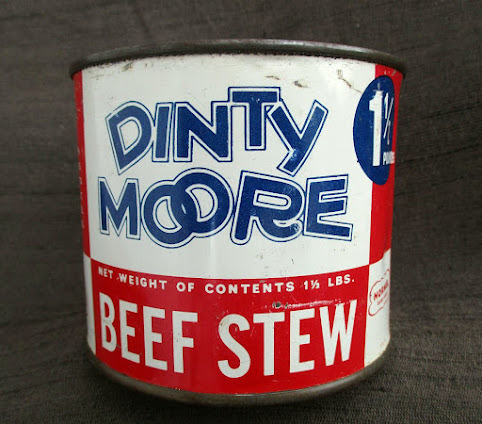
Once again, coming to you from the “I had no idea how complicated this would be when I started” department, we have Dinty Moore, the well known brand of canned soups and stews from the Hormel company. The Dinty Moore brand has included a number of different Hormel products over the years, but the best known is, of course, the beef stew. Some in the know, such as myself, may be aware that a comic strip character of the same name existed prior to the launch of Hormel’s brand, but even they may not know exactly how the name made it from the newspaper onto the can. I certainly wasn’t aware of all the complexities, until now.
In 1913, cartoonist George McManus launched the comic strip “Bringing Up Father,” which he wrote and drew for William Randolph Hearst’s New York American newspaper, and which was syndicated to newspapers across the country by what would later become known as King Features Syndicate. While it isn’t well remembered now, it was very popular in its day, and by the end of its first decade had already spawned several stage plays, live action and animated movie shorts, and multiple reprint book collections. By the time McManus died in 1954, the strip had been syndicated and reprinted in book form worldwide, there had been several live action movies, and McManus had earned over 12 million dollars from the strip. In short, the strip and its characters were very widely known around the world in the early to mid 20th century. After 1954 it was taken over by one of his assistants, Zeke Zekley, and ran all the way to the end of the century, ending in 2000.
The strip mainly revolved around a family of Irish-Americans, comprised of the titular father Jiggs, mother Maggie, and daughter Nora. In many places, these characters were more well known than the title of the strip, prompting many to simply call it “Jiggs and Maggie.” This was also the title given to a number of the live action movies, such as “Jiggs and Maggie In Court” and “Jiggs and Maggie Out West.”
While they had come from a working class background, Jiggs and Maggie had come into possession of a large amount of wealth, and the strip chronicles their struggles with adjusting to the new lifestyle that said wealth brings with it. Maggie and Nora both excitedly take to the high society life, while Jiggs is dragged kicking and screaming into it. Many of the strip’s gags revolve around Jiggs trying to continue to be his working class self, and cavort with this working class friends, to the embarrassment of his wife and daughter.
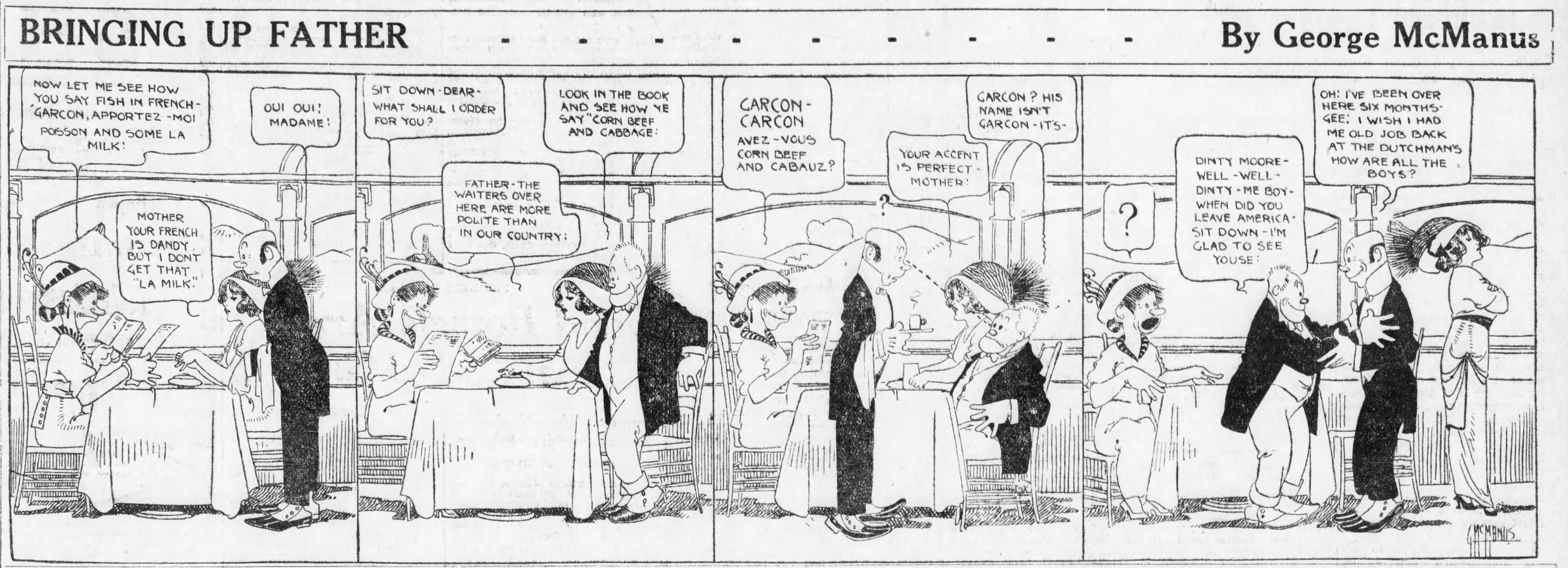
One of the other major recurring characters that everyone knew was, of course, Dinty Moore. In order to get away from high society life, Jiggs would most often attempt to abscond to the local restaurant and pub owned by Dinty, who was his friend. In his first appearance in 1913, Dinty was a waiter at a fancy restaurant in France. There was a series of strips that recounts the family’s trip to Paris, and in one of them they visit said restaurant. Jiggs recognizes the waiter as one of his friends, Dinty Moore, and is excited to see someone he knows from America. Maggie and Nora, on the other hand, were disappointed they weren’t able to impress a local waiter with the French they had learned. Dinty would somehow make his way back to America, and end up running the pub near where Jiggs and family lived.
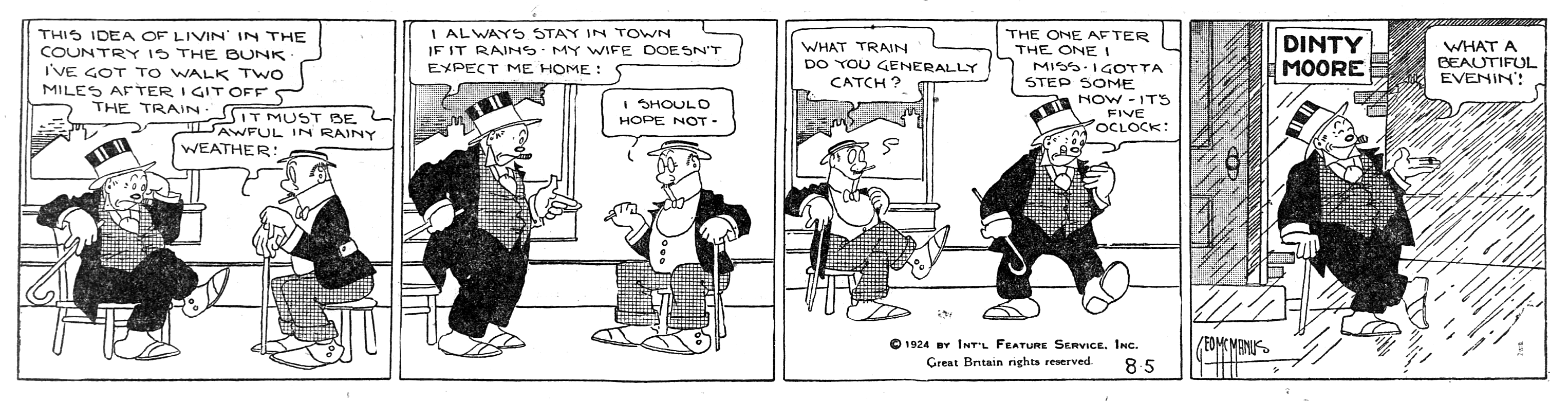
In an article he wrote for Collier’s Magazine in 1952, George McManus recounted how he came up with the character of Dinty Moore. As a young boy, McManus had known an Irishman who worked as a bellhop at a hotel in St. Louis, and who was named Dinty. He remembered and used this name when he created his new character, and gave him the last name Moore, because “it seemed to go with it.”
However, there was another man George McManus knew who had a different idea of where the name and the character came from.
McManus was a frequent patron of a restaurant in New York owned by two brothers, William and James Moore. McManus was acquainted with James, who was familiar with his various comic strips. In the aforementioned Collier’s article, McManus even states he had introduced several of his friends to the restaurant, including people he worked with at the newspaper. Moore had never spoken with McManus much, but as soon as Moore saw there was a character in the comic strip called Dinty Moore and who owned a pub, he immediately assumed it was a reference to him. The Collier’s article doesn’t make it clear whether McManus confirmed or denied this to Moore, but either way, Moore did not hesitate to use it as a marketing tool. He changed the name of the establishment to “Dinty Moore’s” and also started calling himself Dinty Moore, after the character. Either due to the association with a popular comic strip, or due to Moore’s marketing prowess, or both, it became a very popular place for anyone visiting that side of New York to go. During Prohibition, it was well known as a speakeasy, and was frequented by various celebrities, as well as the police, though not always for the same reasons.
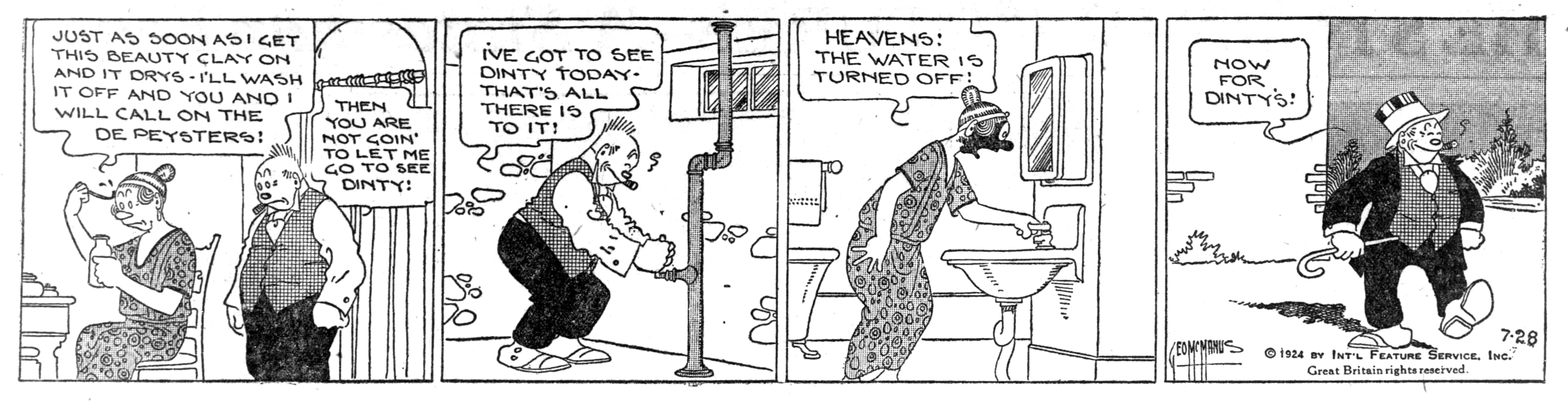
Due to the popularity of the New York restaurant, and the comic strip, other Dinty Moore’s restaurants began opening in various places in the country as well. Some sources claim that James Moore himself opened up a chain of them, though many of them seem to be unrelated. I couldn’t find any evidence to suggest he was aware of all of them, but King Features Syndicate certainly was. An article I found from the Winchester (KY) Sun recounts the tale of two brothers who bought a restaurant there and renamed it Dinty Moore’s, but in order to do so had to get permission from the syndicate (then called International Feature Service). I couldn’t find much in the way of legal challenges to these restaurants, but it’s clear that it did happen.
In a certain case, however, it did not seem to happen at all, and that case is what would lead to the canned stew.
In 1888, Charles Witt opened up a new grocery store in Minneapolis, MN called “Witt’s Market House.” In 1919, it moved to a new location, where it would stay until it closed down in 1968. Witt’s store carried all types of grocery items, but they specialized in meat products. After Witt came up with a new method of curing hams using brine and a “secret solution”, in 1925 they began marketing these hams under the brand name Dinty Moore. Witt’s became an institution in Minneapolis at that time, and Dinty Moore hams became their signature product. It wouldn’t take long for them to start marketing other meat products under the Dinty Moore brand as well, and by 1935 the name Dinty Moore was firmly associated with meat in the minds of much of the populace of Minneapolis. Witt even had the Dinty Moore name trademarked for use with marketing meat products.
Roy Witt, one of Charles' sons, was friends with Jay Hormel, the son of George Hormel, founder of what would later become known as the Hormel Foods company. One day in 1935, as Jay was showing Roy their new warehouse in Austin, MN, he mentioned the fact that a government contract to can beef had fallen through, leaving them with a bunch of empty cans they had nothing to do with. Roy suggested that instead of just canning beef, they add some vegetables and turn it into stew, and even suggested he use Witt’s Dinty Moore brand to market it. An agreement was made between Hormel and Witt, and Dinty Moore Beef Stew was born. Witt’s never expanded beyond downtown Minneapolis and eventually had to close due to lower and lower demand for their products, and the Dinty Moore trademark was eventually fully taken over by the Hormel company. The brand has continued ever since, and it’s difficult to go to the soup aisle of any grocery store and not see it.
Now, I don’t have definitive proof of where Witt got the name Dinty Moore from, or why they decided to market their meat products under that name. I couldn’t find any statements from Charles Witt or his sons about how they came up with it. However, I feel that the uniqueness of the name, the popularity of the comic strip, and the heavy association of the name with restaurants and food makes it very easy to connect it to the comic strip character. The name was definitely in the zeitgeist. Hormel, of course, didn’t take it directly from either the comic or the restaurant, but Witt most likely did take it from one or both of those things, and passed it on to Hormel. Also, while it seems like they shouldn’t have been able to trademark the name if they had taken it from someone else, as we saw with Skippy, trademark law in those days was not nearly as robust as it is now.
Thankfully, unlike Skippy, this story doesn’t have any kind of tragic ending for the cartoonist. McManus never owned the copyright to the strip or to the characters, so he never felt the need to litigate. In my research, I found references to legal challenges from King Features, but I wasn’t able to find when any of these challenges took place, so I’m skeptical of their existence. Even if they did happen, clearly they didn’t amount to anything, and since King Features has never sold any food products, the court would most likely rule they weren’t in direct competition. For McManus’s part, Bringing Up Father made him a very wealthy man, and though he lost much of his fortune in the 1929 stock market crash, he had gained it all back by the time of his death in 1954. …
For More Information:
Bringing Up Father at Don Markstein’s Toonopedia
Dinty Moore’s in Winchester, KY from the Winchester Sun
James Moore obituary where he’s called “Real Dinty Moore”
Dinty Moore at Food Timeline
Take Corned Beef And Cabbage, by George McManus, from Collier’s Magazine, January 26, 1952
On Strips: Bringing Up Father at Kleefeld on Comics
Witt’s Market House at Hennepin History Museum
“Remember Witt’s?” Page 11 and Page 13 from the Minneapolis Star Tribune

